
The year is ending, and everyone’s talking about New Year’s resolutions and big goals for next year. But before you jump into what’s next, there’s something more important you need to do first.
You need an honest end-of-year self-assessment.
Not the fake kind where you only talk about your wins. The real kind where you look at everything; the good, the bad, and the messy parts too.
This year-end reflection isn’t about making yourself feel bad. It’s about understanding what happened so you can move forward smarter and stronger.
What Is an End-of-Year Self-Assessment?
An end-of-year self-assessment is when you take time to think about your whole year. You look at what you did, what you learned, and how you grew as a person.
It’s like looking in a mirror, but for your life.
Personal growth happens when you’re honest with yourself about what worked and what didn’t. This reflection helps you see patterns in your behavior, understand your strengths, and figure out where you need to improve.
Why You Need to Reflect on Your Year
Taking time for self-reflection at the end of the year helps you in three big ways:
- You learn from your experiences. When you look back, you can see what decisions led to good results and what choices didn’t work out.
- You celebrate your wins. Even small victories count. Maybe you didn’t reach every goal, but you probably accomplished more than you think.
- You plan better for next year. You can’t improve what you don’t understand. Reflection shows you what to keep doing and what to change.
Studies show that people who regularly reflect on their performance make better decisions and feel more satisfied with their lives.
9 Questions for Your End-of-Year Self-Assessment
Here are nine simple questions to guide your year-end review. Take your time with each one. Write down your answers if it helps.
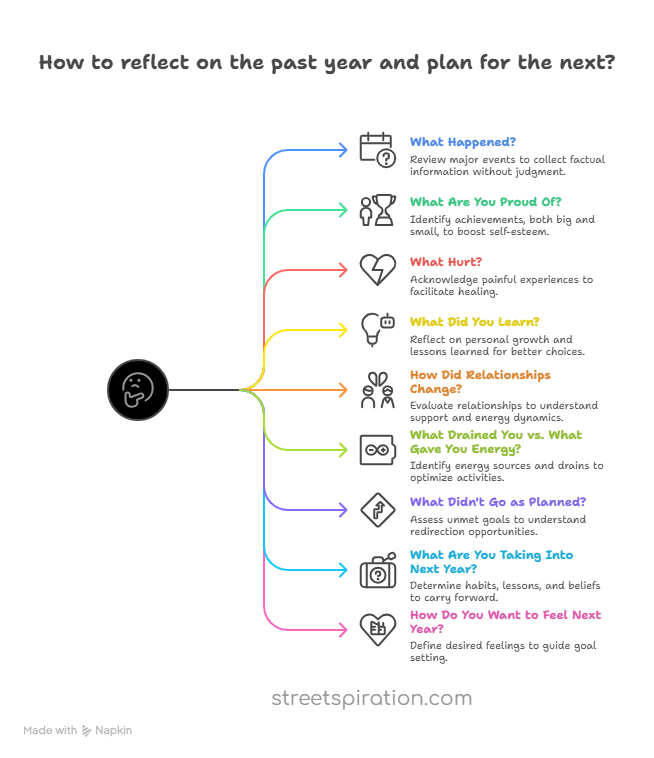
Question 1: What Actually Happened This Year?
Start with the facts. Don’t think about what you planned or hoped would happen. Think about what really happened.
List the major events: jobs you had, places you moved, people you met, health challenges, family changes, and any big decisions you made.
This isn’t about judging yourself. You’re just collecting information.
Question 2: What Are You Proud Of?
Now think about your achievements. What did you do well this year?
Include everything; even things that seem small:
- A boundary you finally set
- A difficult conversation you handled well
- Times you chose to rest instead of pushing yourself too hard
- Projects you completed
- Skills you learned
Not every win gets posted on social media. Some of your biggest victories were private moments when you chose to show up even when it was hard.
Also read: The Difference between Purpose & Destiny
Question 3: What Hurt This Year?
Personal development requires honesty about the hard stuff, too. What was painful this year?
Maybe a friendship ended. Maybe you didn’t get the job you wanted. Maybe you lost someone important. Maybe you struggled with your health.
Name what hurt. You can’t heal if you pretend everything was fine when it wasn’t.
Question 4: What Did You Learn About Yourself?
Think about how you changed this year. What did you discover about yourself?
Maybe you learned:
- You’re stronger than you thought
- You need more rest than you realized
- Certain relationships aren’t healthy for you
- You work better in the morning
- Asking for help isn’t a weakness
These lessons about yourself are valuable. They help you make better choices going forward.
Question 5: How Did Your Relationships Change?
Look at the people in your life. Who showed up for you? Who didn’t? Who surprised you?
It’s okay if some friendships faded. People grow and change. Not every relationship lasts forever, and that’s normal.
Think about:
- Who supported you when things got hard
- Who you felt comfortable being yourself around
- Relationships that drained your energy
- New connections you made
Question 6: What Drained You vs. What Gave You Energy?
This is your energy audit. Make two lists:
Things that drained you:
- Certain projects or tasks
- Specific people or situations
- Bad habits
- Commitments you didn’t enjoy
Things that gave you energy:
- Activities that made you feel good
- Conversations that left you inspired
- Places where you felt comfortable
- Routines that helped you feel centered
This information is gold. It tells you what to do more of next year and what to avoid.
Also read: Struggling to forgive yourself for your past? Read this.
Question 7: What Didn’t Go as Planned?
Be honest; what goals did you not reach? What plans fell apart?
Here’s the important question: Is that actually a problem?
Sometimes things don’t work out because you were heading in the wrong direction anyway. Sometimes “failure” is really just life redirecting you to something better.
Not everything that didn’t happen was a loss.
Question 8: What Are You Taking Into Next Year?
Think about what you want to keep from this year:
- Good habits that helped you
- Lessons you learned
- Beliefs that made you stronger
- Skills you developed
Also, think about what you’re leaving behind:
- Bad habits that don’t serve you anymore
- Negative thoughts about yourself
- Relationships that weren’t healthy
Question 9: How Do You Want to Feel Next Year?
Before you make a list of goals, think about feelings.
How do you want your life to feel next year? Peaceful? Exciting? Stable? Creative?
Goals are important, but feelings matter more. If your goal is to get promoted but you’re already burned out, that promotion won’t make you happy.
Start with how you want to feel. Then build goals that support those feelings.
Making Your Self-Assessment Work for You
Your end-of-year self-assessment doesn’t have to be perfect. You don’t have to answer every question in one sitting.
Take your time. Come back to these questions over a few days if you need to.
The goal isn’t to prove you had a perfect year. The goal is to be honest with yourself so you can move forward with clarity.
Self-awareness is one of the most valuable skills you can develop. When you understand yourself better, you make better choices. When you make better choices, your life improves.
Also read: 3 Benefits of Self-Awareness
Moving Forward
As you finish reflecting on this year, remember: you’re not supposed to have everything figured out. Nobody does.
Personal growth isn’t about being perfect. It’s about learning, adjusting, and trying again.
You showed up this year. You survived challenges. You learned things about yourself. That matters.
Give yourself credit for how far you’ve come. Then use what you learned to build an even better year ahead.
Your end-of-year self-assessment is complete. Now you’re ready for what comes next.